John Mosely
Dark Lies the IslandJohn Mosely, usually called Big John, serves as a steadying presence in the Real Ale Club: the man whose confident interventions give the group’s noisy fellowship a measure of direction. He is presented as a father figure among the club members, but his authority is not merely ceremonial. He leads them into business, makes the decisive call on their scoring system, and steps in when a companion’s joking turns uncomfortable.
Identity and Place in the Club
The narrator identifies John as the club’s dad figure, describing him as someone prone to know-it-all interruptions. That combination makes him both a familiar source of interjections and a source of practical authority. During the club’s journey to Llandudno, he comments on the town’s Victorian planning as the narrator reads from a guidebook, then questions the idea that the resort was laid out on marshland. The exchange establishes the conversational texture of the group: John is quick to assert what he thinks he knows, and the others continue the discussion around him.
His fatherly standing is reinforced by the way he handles responsibility. As the group approaches the club’s decision about how to score beer, John rubs his hands and leads the others onward, reminding them that they have business to attend to. The gesture and reminder shift him from commentator to organizer: he helps the group move from banter toward a decision.
Leadership and the Scoring Decision
The club’s debate concerns whether to retain the National Beer Scoring System, which ranks beer from zero to five, or adopt the Real Ale Club’s Merseyside branch’s more finely graded scale from zero to ten. The older system runs from a beer fit to be returned through middling and good examples to the rare five-point beer; the club’s alternative is intended to recognize smaller differences in quality. The dispute therefore concerns not only a number, but how precisely the members want to describe what they taste.
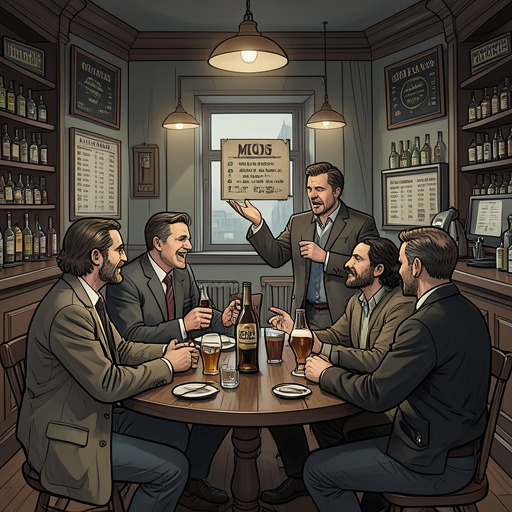
The narrator describes a moment of emotion as the discussion reaches its conclusion. Everett says that their system is better, and John answers in agreement. The narrator calls John’s approval the clincher: his judgment carries enough weight to settle the matter. When the narrator then says that the group’s agreement is sufficient, the club members link arms on a hot pavement and head for the Heron Inn. John’s call turns a long-running preference for finer distinctions into a shared rule, and the group’s physical togetherness gives the decision a communal close.
Care and Social Boundaries
John’s authority also appears in a smaller, more personal exchange with Mo. During the Llandudno trip, Mo speaks about a young woman and recounts their earlier relationship, including her move to England, their arrangements to speak by telephone, and a month they spent together in the summer. John tells him to leave the subject alone. The narrator says Mo does not, so John’s intervention is not shown to end the talk; it does, however, mark John as willing to set a boundary when the joking or reminiscence carries on.
The episode complicates the club’s boisterous masculine sociability. Its members drink, tease, interrupt, and trade stories, but John’s role includes the authority to signal when a companion has gone far enough. His paternal position is expressed less through any declared sentiment than through these acts of guidance: directing the group’s business and trying to rein in a friend.
Male Fellowship and Narrative Role
The novel places John’s authority within a brotherhood built around drinking, travel, and shared routines. During a train journey, the men drink Marston’s Old Familiar and recall visiting Mo after an operation. They had stopped at the Ship and Mitre beforehand, and the group gathered around Mo in the hospital, joking with him gently. The account presents their rough humor alongside a recognizably protective form of companionship; John’s later attempts to check Mo’s talk belong to the same social world of teasing and care.
John is therefore not defined by a separate personal storyline in the available scenes, but by the function he performs within the ensemble. He supplies the club with a recognizable dad figure, turns collective discussion into action, and occasionally checks the group’s excesses. His certainty can appear as know-it-all interruption, yet it also provides the confidence that allows the members to reach a decision together.